Wednesday, October 26, 2011

the personal is political.

Today, I was a bitch to a complete stranger.

Granted, he started it. He asked me that dreaded question, which goes along the lines of WHAT ARE YOU?!?! Since this is #1 on my rage list, I decided I was going to stop being nice about it.

I had my headphones in, waiting for a bus home from work. This was the second leg of my trip, meaning the bus stop was in Koreatown. Due to my headphones playing loud music, I delayed in realizing that a guy around my age was talking to me. I took out the headphones, he repeated what he said, and I didn't understand him, which I registered was because he wasn't talking to me in English.

This is where I made an assumption, which now, thinking back on it, conflicts the situation (explained further down). This guy was Latino, or at least I had categorized him as such, so I replied, "Sorry, I don't speak Spanish." He gave me a strange look and repeated his non-English phrase. It took me a second (seeing as it was obviously not a language I understood, which should have been very clear to him by now), and then I realized he was greeting me in Korean.

I told him I didn't speak Korean either. I said it curtly, as by now, I knew where this was going. But he didn't take the hint. He asked me if I was Korean. I said no. He asked me if I was Chinese. I said no. All of my answers were short, because I wanted this conversation to be over. I put my headphones back in, but he kept talking to me, moving so he was in my view, and I couldn't ignore him. I took the headphones back out, out of some semblance of decency. He asked me what my nationality was. I said American--after all, I was born here and am solely a U.S. citizen. My "nationality," as he put it, is without question American. But of course that wasn't what he really wanted to know. So he persisted.

I asked him why he needed to know. I meant to question why he felt the need to categorize me, a stranger on the street whose name he didn't even know, into some ethnic group, as if that would somehow resolve his life. But at this point, I was becoming more and more frustrated, and I didn't really know how to articulate what I meant, so he might have taken it the wrong way, as if I was accusing him of hitting on me. He said he was just curious. He could tell I didn't want to talk to him, but for some reason, that made him try even harder. Even though I then expressly told him I did not want to discuss my "nationality" with him (how much clearer can you be?), he persisted.

So I relented. I said I was Taiwanese.

He was all, "Finally! That's all I wanted to know. Ni hao!"

I said, "I speak English, you know." BECAUSE THE WHOLE CONVERSATION BEFORE THIS HAD BEEN CARRIED OUT IN ENGLISH.

It ended with him taking off in a bit of a huff after saying that he hoped I'd have a "better" day. And honestly, I was left not feeling much better than I would have had I just played nice. My response didn't stop my blood pressure from rising. It didn't stop me from leaving the situation stressed out and replaying it in my head for the next hour to figure out what I could have said instead. It didn't stop me from questioning myself, except instead of wondering why I didn't stand up for myself, I was wondering how I could have handled it better so that I didn't come off like such a bitch. Maybe next time the guy who's asking me (because it is overwhelmingly men who do this to me) won't be so nice about my hostility, and the situation could escalate. Regardless, I just wasn't happy that I left the situation feeling like I had been in the wrong. Like I should have just been nice about it. On top of that, I kept on thinking about how I had categorized him as well. I had assumed he was speaking Spanish when he said something to me in a different language. I had demonstrated that I too wasn't perfect, free of assumptions about other peoples' racial and ethnic identities.

But it's not that simple. I may have made an assumption about his ethnicity, but assumptions about race are human heuristics that help us process information. And I'm aware that that's all it is. I didn't approach him and speak to him in Spanish, as if he couldn't speak English and wasn't American. Hypothetically, if we had entered into a real conversation about racial and ethnic identity, I would have been receptive to his self-definition, rather than giving him choices to select from as if those categories said everything about his identity (Mexican? No? Guatemalan? No? Really? I'm just curious!).

In retrospect, I feel better about my reaction. I'm glad I didn't play nice, because there were so many things wrong with this situation:

  1. He approached me, even though I clearly didn't want to speak to anyone, as evidenced by the clearly visible headphones (my hair was up). 
  2. He opened the conversation by speaking to me in Korean.
  3. When he found out I wasn't Korean, he needed to know "what I was," other than American.
  4. He persisted, even though my curt responses and hostility made it clear to him I didn't want to talk to him about this. It wasn't like he was thick either, because he also got more tense as I did, saying he just wanted to know, he was just curious, that I didn't have to be so abrasive about it.
  5. When he finally found out that I was Taiwanese American, he greeted me in Chinese. Even though we had just had an entire conversation in English. What if I didn't speak Mandarin, even though I'm Taiwanese? Many Taiwanese people speak Taiwanese or Hakka. On top of that, what if my parents never taught it to me, or what if I were 3rd, 4th generation and monolingual in English? Those are hypotheticals, sure, but in real life, I am extremely uncomfortable speaking Chinese to anyone who's not my family. Once, I remained silent while an entire group of Chinese tourists milled around me trying to figure out the bus they were supposed to take. I understood what they were saying, but I was terrified that they'd ask me for directions. They did. And I was so, so embarrassed in how haltingly I expressed myself.
There really wasn't much of a reason to play nice. The entire situation was overlaid with male privilege (i.e. that he approached me in the first place when I clearly didn't want to be bothered, and that he persisted even when I made it clear I didn't want to talk, as if women have to be receptive to strange men approaching them) and assumptions about ethnic identity (i.e. that he easily categorize me and my experience based on what ethnicity I am, or that he can just ask me a deeply personal and invasive question 30 seconds after initiating conversation with me).

I do still wish I had handled it better. Maybe I should have been less off-putting. Maybe, instead of saying no, no, no, I don't want to talk to you, I could have replied, my ethnic identity is a topic that's too personal for me to discuss with someone approaching me off of the street. Please understand that I don't want to have this conversation just so that you can categorize me into some group, and I don't think that you should make assumptions about me and what language I speak based on my "nationality," which is in fact American, as I was born here. Maybe that would have been strong but also polite. And maybe that would have been firm and articulate enough to end the conversation, which is ultimately what I wanted to do. I didn't want to make his day worse by being mean. I didn't want to give him a lecture on male privilege or racial and ethnic identity, either. I just wanted to stop the conversation.

---

At this point, I've accepted that situations like this are bound to happen. The next time it does, I'll try the response I just came up with, and see if it lets me end the conversation without feeling like a doormat but also without feeling like a douchebag. Practice makes perfect, right?

Saturday, October 22, 2011

Slutty.

One of my favorite holidays is coming up soon. Yup, that's right, I'm talking about Halloween. I love it. Or, perhaps more precisely, I loved Halloween. When I was little, I loved getting dressed up, being someone completely different, and getting rewarded for it with lots and lots of candy. Even when I was older, I still loved it. I loved the campiness, and considering that fall is my favorite season, I loved going out to haunted houses and such in the crisp fall weather.

However, lately, I've been losing my enthusiasm. Mostly it's because, as an adult woman to whom a Halloween costume actually means something as an expression of myself and my creativity (which usually translates into my knowledge of fantasy and superhero characters), I've run out of costumes.

I don't want to be a sexy bumblebee. It's such a cop-out. I've never thought, hey, wouldn't it be great to be a bumblebee? Or, wait, maybe a sexy bumblebee! That would really speak to how I want to express myself the one night where it's socially acceptable to wear a completely outrageous costume in public!

I'm not disparaging the sexy bumblebees (or the naughty Nemos, sexy watermelons, or stinkin' cute skunks). As absurd as "sexy" Halloween costumes can be (as the above links show), if an adult woman wants to wear one, then by all means, she should. I'm not going to put her down for it. I just don't want to do that myself. I'm not saying that I want to put on one of those Angry Birds costumes and feel totally cumbersome and uncomfortable in my costume either. On Halloween, I want to live up my fantasies and be something/someone awesome. For me, personally, that's not a sexy watermelon.

My costumes for the past four years have been as follows: Harley Quinn, Poison Ivy, a panda bear, and Trini, the Yellow Ranger on the original Power Rangers. You might see a pattern emerging. With the exception of the panda, I've chosen superheroes/villains because, on the one night that it's cool to do so, I want to be a fantastical, not to mention, an ass-kicking woman. And I did somewhat sex it up for the two villainesses. Given the opportunity, I enjoy feeling like a fearless, confident, even sexy fantasy character. All of the costumes were easy to make as well, given twenty bucks and a bit of time. While I love dressing up, I refuse to pay $50+ for a mass-produced costume made of cheap materials that I'm only going to wear once.

This year, I decided to switch it up. I'm going to be Batman. Not Batgirl, Batman (because who wants to be the token girl version when you can be the actual thing?). I'm not planning to buy the costume with the foam pecs and abs; I'm going to gender-bend Batman so that I can, as mentioned, feel confident and comfortable, as well as not spend a lot of money. But I was planning to get the Batman (not Batgirl) mask. So today, finding myself with 15 minutes between meetings, I decided to visit the seasonal Halloween store in my neighborhood to look for a mask. I asked a salesperson to direct me to the Batman masks, and as I was trying it on and laughing at how bizarre I looked with my female face in the hyper-masculine, angular mask (which was modeled after the Nolan Batman costume), I overhead this conversation between a father and his very young daughter:

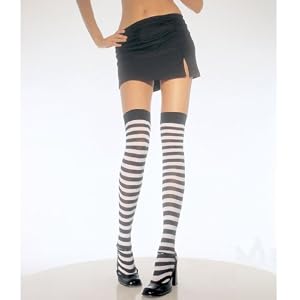
Daughter: (looking at the tights selection, which includes thigh highs and fishnets and such)
Dad: Those aren't for you; those are for the big girls.
Daughter: Like mommy?
Dad: Yes, and also college girls who want to look slutty.

OH. MY. GOD.

I don't know if I detected a note of condescension in his voice since I was in earshot (in which case, fuck you, unknown dad, because I am a grown-ass woman who can choose for myself whether I want to look "slutty," and on top of that, it's unfair and misogynist of you to assume that all girls my age want that). But what took me aback even more was that he even uttered this word in front of his daughter, who could not have been more than four years old.

OK, kiddo, this is what loose women look like.

What is he teaching her about gender, sex, and sexuality by using words like that as normative? I know his daughter is way too young to think about the above concepts, but what's acceptable to expose your child to at this age will make a difference. At her age, shouldn't a word like "slutty" (and variations thereof) be off-limits as a "bad word?" What if she asks him what it means? "Oh, it's a word that people use to degrade women that they don't feel conform to patriarchal social norms. Sometimes, people use it to just put down women/a woman in general regardless of her actual sexual behavior." But I think from his casual usage of the word that, if asked by his toddler to explain what slutty means, he would not have offered the aforementioned description. And that's what makes it even worse.

By calling something (and, by inference, the girls who choose to wear that something) slutty, this dad is teaching his daughter it's okay to call people, specifically women, slutty. He's saying that one can make assumptions about women's worth based on their sexual behavior, or not even their actual behavior, but what they choose to wear. This word, and all words like it, are so very problematic. "Slut," "whore," "skank," etc., are all gendered words that relay a patriarchal, double standard on social expectations of sexuality. Furthermore, these words have been used to disparage women and reinforce misogyny in a variety of ways. For example, women who dress "slutty" deserve to be raped or sexually assaulted. Women in the public eye should dress well but not "slutty" (which can be as conservative as accidental cleavage) in order to be taken seriously. Using this word with a four year old implies that there are some hard-and-fast rules as to what slutty is, and that this will help identify women whose characters are lacking, and that if you avoid any "slutty" behaviors or wearing anything "slutty," you can avoid ever being a victim of that word and the full onslaught of misogynistic barriers that are its foundations.

---

I would never use words like that with my children; I try to not use those words in general. If I had a daughter, I would make sure that I never impart to her that the way she chooses to express herself, whether through her behavior or her dress, says anything about her inherent value. I understand that when you're a parent, you probably never want to think about your four year old daughter wearing thigh high tights, and hell, I honestly wouldn't let my daughter--at any age, as long as she's still a child and living in my house--wear thigh highs. But I would do all this in the hopes that, when she is an adult, she will be conscientious, confident, and well-adjusted (and a feminist). And she'll understand that maybe I would disapprove if she decided to be a sexy bumblebee in college, but I would never make a judgment on her character for it.

It's unrealistic of me to expect all parents with daughters to be feminists, so I don't expect it. But I do expect that parents won't make their daughters feel like their self-worth is linked to the way they dress and their sexual behavior. I know that simply using the word "slutty" to describe tights to a four year old doesn't necessarily impart this message. I just thought that having a daughter would make parents, especially fathers, question what they teach their daughters, knowing that their daughters will face enough of an onslaught on their self-esteem and body image from the public and the media.

Maybe this expectation is unrealistic too. What do you think?

Wednesday, October 12, 2011

LA flea market finds make me miss Chicago.


The MSI postcard (top) is from 1939. $1 each at the Melrose Trading Post for an incalculable amount of nostalgia.

Monday, October 3, 2011

my unexpressed rage.

This post originally started as a rant on an incident of street harassment that I experienced a few days ago. Yet, the purpose of that post was mostly to unwind and let go of my anger at the incident. I realized that, although it made me feel much better, it ultimately didn't contribute anything to my blog.

I've written about street harassment before. In that post, I described deciding whether to express my rage at being harassed as a conflict between safety and power. More and more, however, I'm realizing that the conflict isn't that simple. Yes, there are elements of safety that often inform my decision to stay silent and pretend like nothing's happening, like I can't hear the catcalls. But if safety were the only factor contributing to my disempowerment, then why wouldn't I take a chance when I can, when safety isn't as much of a concern, to express my anger?

This time, I had no concern about safety. I was walking home well before sunset, and the incident occurred at a bus stop with students standing around waiting for the bus. I didn't even see it coming, so preoccupied I was with how I was progressively getting sweatier and more disgusting carrying my large bag of groceries up a hill. In other words, I didn't even look at the guy or have a chance to assess whether or not he seemed like a threat. So when he murmured, "hey cutie," as he was passing by, his voice too low for anyone else to hear his misogyny, why didn't I draw anyone else's attention to it? Why didn't I tell him to fuck off? Why didn't I give him an impromptu lesson on how he was infringing on a woman's right to be in public unharassed?

I don't know. I just didn't. By the time I registered that I should give him a vivid description of where exactly he could shove it, it was too late. I would have to turn around, run back to get within earshot, and then yell like a lunatic at him as he walked away. And so I kept walking, seething in my complicity.

Because that's exactly what it was: complicity. By repressing my rage at the injustices I face, I am complicit in reinforcing the inequitable social ideologies that make these injustices okay. Repressing my rage is just as good as, "Why can't you take a compliment?!" Repressing my rage is the same as, "I was just interested in what your heritage is." Repressing my rage is no better than saying, "Don't try to make it into a race/gender/whatever thing."

There is a book by a preeminent black feminist, bell hooks, called Killing Rage that I've been meaning to look into since I read the first chapter for one of my classes this quarter. In this introduction, hooks describes the "killing rage" she felt at a series of racist incidents that she experienced over the course of a day. One of her main points in this introduction is how black Americans have become skilled at repressing their rage, particularly those who move up on the socioeconomic ladder and want to gain access to the benefits of material privilege. Yet, by repressing and annihilating rage in order to assimilate, blacks become complicit in a racist structure that has no place for black rage.

Although hooks was writing specifically about the black community, her points resonated with me. I felt that they could apply to any marginalized community, whether communities of color, women, sexual minorities, or any other community. How many times have I repressed my rage at a racist/sexist incident? How many times have I then been complicit in reproducing the exact unequal structures that I despise?

Unfortunately, the answer is: too many.

Hooks is right. I'm afraid and even ashamed of my rage. If I express it, I will be ostracized. Yet, at the end of the day, every time I don't express it, I feel deflated and disempowered. I take to my blog as a crutch, a quasi-public way to tell the world that I do get angry at injustice. But really, it's not enough.

We discussed in class how hook's book title, Killing Rage, is a play on words. Not only is she talking about the intensity of the anger that she felt in response to her anecdote, she is describing that this rage must ultimately be "killed," in a way. It must be expressed productively, through organized, collective anti-racist struggle. I hope that I will become a part of this struggle in my own way, but I think that first I need to work on my own personal commitment to this and other struggles against injustice. I can read and write as much as I want about race and gender and culture and etc, but if I let myself be complicit in the structures that allow racism, sexism, xenophobia, microaggressions to exist, then how am I ultimately true to myself?

So, to begin with, I've started a list of microaggressions, all of which I have experienced multiple times, to which I need to work on better responses. Responses that allow me to express outrage, but are still appropriate and will hopefully cause the perpetrator to think instead of become hostile. Suggestions as to what you do (or even what you wish you would do) are appreciated!

What I'm Enraged About:
  1. Being asked where I'm from; no, where I'm really from (and if you'd like to read about a day in which I was asked this three separate times by three strange men, read this);
  2. Being called exotic, or a geisha, or a China doll, or anything else that "compliments" me by bringing my race into the equation in a stereotypical and offensive way;
  3. In addition to the previous, being called anything that relates to my appearance (e.g. the aforementioned "cutie") by strange men;
  4. Having people speak to my parents very slowly and loudly, because they have accented English, even though they've been in the US, using English in their jobs and day-to-day social lives, for over 30 years;
  5. Being told I'm "white-washed" or "acting white" or "not a real Asian;"
  6. Being told to "cheer up!" or "smile!" by strange men;
  7. Having strange men (again! of course!) say "konichiwa!" or "ni hao!" or variations thereof to me (luckily, though, I've never had Stanley Kubrick repeated to me);
  8. Having people (usually older adults I don't know very well) comment to me, in otherwise pleasant conversations, how they were once in China or Japan or Korea or some other Asian country once and how they loved it and how they love Asian art and Asian food and all things Asian (just like me!);
  9. Being unable to exist in a public space without regular street harassment, unable to live my mundane life doing my errands, riding the bus, walking home without a man hitting on me, uninvited and unwanted; and
  10. Being told that I look like (insert famous Asian or Asian American woman here, the most memorable example being "the sisters" who were detained in North Korea, a.k.a. journalists Laura Ling and Euna Lee, who aren't sisters) who I look nothing like.
I have labeled this post "rage list" because I would like to continue this project. I'm viewing this as an interaction in which readers can comment with suggested responses or their own related incidents in which they have been enraged at a social injustice they personally experienced but repressed their anger. Any incident that relates to broader social injustice, including those that don't have to do with race and gender, is welcome. Hopefully, together we can arrive at productive ways to ensure that we are not complicit in the structures we hate.

Tuesday, September 20, 2011

colloquialisms.

Although I'm no linguist, language is very intertwined with several things in which I am interested. Writing, for example, with this blog serving as evidence that I can't really get by in life without putting my thoughts to paper/website. On the flip side of that is reading, from other blogs to news to esteemed and not-so-esteemed periodicals to novels to literature. During my foray into being a psychology major in my early college years, language came up quite often as well, both in developmental and social psychology. And language is one of the most important components of the thing I am interested in pretty much above all else--culture and all of its aspects and complexities.

All of this is to say that I found myself pondering the language quirks of the places I've lived in on my ride home from LAX. You see, LA is notorious for its traffic, and I was sitting on a shuttle bus from LAX that decided to take the I-405 instead of local routes. So of course I was agonizing in my head about why the bus driver had chosen to take the "freeway." Then it hit me--I was using this word, "freeway," in my thoughts when not even 24 hours earlier I had been in a place where that word pretty much doesn't exist. I'm sure that had I any reason to talk about such things in DC, I wouldn't have used the word "freeway," nor would I have thought twice about what to call it.

I would have used "highway" or "tollway," because in Chicago where I learned my particular dialect of American language, highways are definitely not free. When I first moved to LA, "freeway" was one of the changes in language I adapted to. It took me a while, but I would consciously catch myself because I wasn't sure that people knew what I was referring to when I used "highway." And now, it's apparently gotten to the point where I can seamlessly transition between the two colloquialisms, depending on where I am, without a conscious thought.

I think that's abso-fucking-lutely amazing.

(Side note: other colloquialisms I had to get used to included euphemisms for swears I deploy without hesitation, e.g. freaking, hella, etc. Apparently, Chicago causes one to swear like an especially crass sailor. Case in point: Governor Rahm Emanuel.)

The idea that the human brain has such a complex understanding of language that it can fine tune the words that come to the tip of your tongue depending on where you are is mind-blowing. It makes you (or at least, it makes me, with my BA in Biological Sciences) think about how amazing a process evolution has to be to develop human language and about how incredible language is. And, above all, it makes you think that there may be infinite capability in that three pound organ that sits in your head.

Monday, September 19, 2011

a new take on the HPV vaccines.


I am currently finding myself with a bit of extra time in DC while Boyfriend does his going to class thing (hooray for quarter systems and not starting classes until a month after everyone else!). So of course, I'm using this time to catch up on my news and blog reading, which often leads to posting on my very own blog!

It's not as if I didn't hear about it when Michele Bachmann stated during the GOP debate that she is opposed to "innocent" girls getting "government injections." I just kind of ignored it, because that's what I tend to do when it comes to right-wing presidential candidates with crazy eyes. But of course, controversy around the HPV vaccine is still blowing up the news and blog universe, and I recently came across this article on NPR: HPV Vaccine: The Science Behind The Controversy. 

The article states the obvious ("It appears this vaccine gets people riled up because it involves sex and 11-year-old girls" THANKS NPR), but at the same time, also provides an easy-to-understand summary of the scientific arguments for and against vaccinating young girls against HPV. This perspective is one that I haven't thought or read much about since the normal discussion is much more caught up on hand wringing over the whole sex-and-young-girls thing. And one particular argument made against the vaccine made me question my own unconditional support.

I got the Gardasil vaccine about four years ago, around when it first came out. My doctor said that it might not be as effective as it would be had I gotten it earlier, since I was already sexually active and therefore could have already been exposed to HPV. Regardless, she recommended that I still go for it. It was expensive and inconvenient, since it required three separate shots, but at the same time, it was a no-brainer for me. Why? Because of the following...

The Basics
  1. Gardasil/Cervarix are vaccinations against the human papillomavirus (HPV). There are more than 40 strains of HPV, making it the most common sexually transmitted infection (STI). The CDC estimates that at least 50% of sexually active men and women get it at some point in their lives, but I've seen higher estimates as well (CDC, 2011). Many strains are cleared by the body and do not cause any clinical symptoms, but some strains cause genital warts, and some cause cervical cancer--which kills about 4,000 women a year.
  2. While Dr. Harper is correct in stating in the NPR article that most women who get HPV do not get cervical cancer, there is no arguing with the fact that cervical cancer is directly caused by certain strains of HPV. Cervical cancer is one of the only cancers with as clear and direct a cause as this. Virtually all women who develop cervical cancer were infected with HPV. The vaccine protects against four strains of HPV--two that cause genital warts, and the two most common strains that cause cervical cancer.
So I hardly thought twice about it. Fortunately, I didn't face the barriers that many less privileged women face to health care access--I had health insurance, I had money to cover the co-pay, and I had the ability to be able to go to the doctor three times to get three shots. So why should I not take advantage of this and protect myself against a virus that could kill me?

On Prevention, and Why the Vaccine Works (Better)

As I mentioned, however, I wasn't the target population for this vaccine. Vaccines are intended to be primary prevention. This means that they protect those who have not yet been exposed to a disease. Vaccines, as you all probably know, usually contain attenuated or dead forms of a disease agent (bacteria or virus), causing your body to mount an immune response that will allow it to effectively fend off the real agent in the future. This is why vaccinating young girls is the issue--the ideal population to vaccinate would indeed be young girls (and boys, but that's another story) since they are not yet sexually active. In essence, they haven't been exposed and when they are, they will already have effective defenses.    

Dr. Harper also makes the argument that Pap smears, not vaccines, are the biggest thing that women can do to protect themselves from cervical cancer. A Pap smear is an exam that checks the cervix for abnormal cells and is generally done yearly (although the controversy over those recommendations is yet another story--there are many stories in women's health!). Abnormal cells on the cervix may indicate cervical cancer or pre-cancerous lesions. Pap smears thus serve as secondary prevention. They don't protect women against infection, but they do allow early detection of a serious disease. Like other cancers, if detected early, the survival rate for cervical cancer is greatly increased. Thus, Pap smears are very much a significant step that women can take to protect themselves against cervical cancer, especially women who missed the optimal window for the vaccine, like me.

However, when given the choice between preventing a disease before it happens and catching a disease early, my inclination is to go with the first as a more effective preventive health strategy. But what really made me question whether the vaccine should be given to young girls was the last point Dr. Harper made.

Girls as Guinea Pigs

"[S]tudies so far show the vaccines protect for four or five years. Scientists hope protection will last for 10 years or more, but it's possible young women may need a booster shot later."

I know that I can't expect scientists to test a vaccine or drug or procedure for decades and decades before seeking FDA approval to see how long it lasts or what the long-term effects are, but still. This surprised and, honestly, bothered me. The HPV vaccine, especially Gardasil in my personal experience, has been part of a huge marketing and lobbying campaign that aims for universal coverage. At the same time, not everything is known about it; in this example, for how long it is effective. If we gun for vaccinating all middle school age girls now, don't we face culpability if five years later, many have been infected with HPV because the vaccine's effectiveness has worn off without their knowledge? To push for universal vaccination now would be like using these girls as guinea pigs, and it may not turn out in their favor. This definitely wouldn't be the first time that women have been guinea pigs for an FDA-approved drug/vaccine/procedure. It took more than a decade after combined oral contraceptives (COCs or estrogen/progestin or "the Pill") were approved by the FDA to establish that the commonly used dosage of estrogen carried a high risk of blood clots and therefore stroke and heart attack. The dosage and the risk have consequently been reduced, but not before millions of women used the first generation of COCs.

Often it feels like my inclination towards the best preventive public health strategies struggles with the medical-pharmaceutical industrial complex. Yes, I want to be able to prevent cervical cancer as effectively and as early as possible, but I'm hesitant against unconditionally supporting the vaccine until there are less uncertainties. I still see many more benefits to vaccinating early, but this NPR piece helped me realized that, as in everything else, money seems to play a role in this debate.

Saturday, September 10, 2011

apologies!

I know that I promised at least weekly blog posts from now on. But for the next couple of weeks, dear Reader, please bear with me. I have a really interesting post (I hope) planned soon about the neighborhood that I'm doing my Master of Public Health internship in, but unfortunately, this weekend has been packed (mostly with social things, like seeing the National !!!), and after I finish work this week, I'm leaving for a mini vacation. So I'm not sure if I'll be able to keep it up for the next two weeks, but I promise I'll be back! And hopefully as entertaining as ever!

Saturday, September 3, 2011

angry birds, i'm angry.

This morning, I downloaded the newest version of Angry Bird Seasons, in the theme of  Mid-Autumn Festival, a harvest festival which is celebrated by a number of Asian cultures.

It's great that such a popular game is celebrating a major Asian holiday. I love Mid-Autumn Festival. My more recent memories of celebrating it involve going to Chicago's Chinatown with my family, eating lots of good food, and buying mooncakes, which of course makes this holiday one of my favorites, considering all of the eating.

But really, Angry Birds? I could have done without the rice paddy and fake queue hats.


The game icon was the first thing I noticed when I was downloading updates to my apps, considering that the icon made me uncomfortable as soon as I saw it--an angry red bird with a rice paddy hat. While Asian farmers might have worn rice paddy hats in the past (and probably still do), the only people I routinely see wearing them are white or other non-Asian kids in Chinatowns because they think it's funny. And it is "funny" if you're privileged and don't really care to understand or be sensitive to other cultures and their history in the U.S. The rice paddy hat is kind of the universal symbol of "chink." The only other places I routinely see them are in racist caricatures and cartoons. So, you know, this isn't really the best symbol to choose for your icon honoring an Asian holiday. Needless to say, I opened the game with apprehension.


While it was loading, my heart sank at what I noticed on the floor--a fake queue hat. Another derogatory symbol! The queue has a long history of tradition, resistance, and controversy in China. Under the Qing dynasty, the Chinese (including those who immigrated to America, since they often wanted to return to China) were forced to wear it. This essentially made it into a symbol of perpetual foreignness in America. And thus it was used in racist ways to portray Chinese Americans, and currently, it continues on in much the same way as the rice paddy hat does. So Angry Birds isn't doing so well for itself, and the generic Asian symbols outside of that ("Asian" font, pagodas, Asian style clouds) isn't really helping.


Here's the home page. I can accept the lantern. And the "Asian" Angry Birds theme song, because it's kind of cool, if generic and conflating of a diverse range of different cultures.


And here's the actual game. It's the Year of the Rabbit! I do enjoy the little rabbit figurines and the rabbit in the moon. Granted, this would have been more fitting during Lunar New Year, which was about seven months ago, since the Year of the Rabbit has pretty much nothing to do with Mid-Autumn Festival. But better late than never, I guess? I'm probably biased because I was born during the lunar year of the rabbit. There's also a fan and a teapot, because (remember?!) this is an "Asian" holiday!

But GOD, those rice paddy and fake queue hats have really got to go. Look, Angry Birds, I appreciate the attempted homage to my culture and the inclusion of a major Asian holiday in your Seasons series. But I think that in order to properly represent an Asian holiday without perpetuating tired and, honestly, kind of racist tropes, you should have tried harder. For example, maybe next time actually research the holiday and figure out what icons would be appropriate to use (where are the mooncakes?! and firecrackers?) rather than recycling stereotypes. Mid-Autumn Festival is a huge tradition that is celebrated by many very diverse cultures, including those that aren't included in your stereotypical "Asian" symbols. And a few of your symbols have rather complicated histories that result in their reproductions today being kind of problematic. People still would have gotten the point (i.e. THIS IS AN ASIAN HOLIDAY LOOK AT THE ASIAN ANGRY BIRDS AND PIGS) without symbols that border on racist and derogatory.

Wednesday, August 31, 2011

for Mandeep.

A college classmate and acquaintance of mine recently passed away. I had a longer post written, but I ultimately decided that it did not do him justice and that, considering those closer to him who feel greater pain, I am in no position to write about him.

All I can say is that his passing fills me with an incredible sadness, and that speaks to how greatly he will be missed by everyone who knew him.

RIP.

Saturday, August 20, 2011

white girl donation box.

My roommate (hi Denise!) and I were recently having a conversation about nail polish colors, specifically about how we both sometimes fell prey to the urge to buy a "trendy" color, regardless of knowing that it will not look good on our nails. Case in point:


This is a trio that I have affectionately dubbed "my white girl colors" - a bright aquamarine, a color called "Gunmetal" that is dark metallic grey, and a cool pink. All were purchased because they were on trend (except for the pink; I don't know what I was thinking when I bought that atrocious Barbie color). I had seen them displayed in magazines, makeup stores, and drugstores until my mind became convinced that my nails, too, would look good in these colors.

Well, let me tell you. These colors were on trend because some designer put them down the runway on his--more likely than not, but that's a story for a different time--white models. Guess what? Not as great on Asian skin tones. Or, in the case of my roommate, Latina skin tones. Especially that grey one--I was so happy when I finally bought it as I had been eyeing it for weeks after loving the way it looked on (white) models in magazines. Then, when I got home and put it on, I was so, very disappointed when I realized how discordant it looked with my skin tone, and I haven't used it since.

My roommate and I jokingly decided that we should give our white girl colors away--put them in a box, label it "White Girl Donation Box," and leave it outside our door. But who are we kidding? When the American fashion and beauty industry is largely centered around the norm of white beauty, it's not like girls who fit that "norm" will need throwaways from girls who don't.

Further examples:
  • "Tribal" prints - please. You have to be reeking of white privilege to not realize that the trend itself and how the trend is often marketed often border on offensive or are outright Just Not Okay.
  • Hair color - you know those John Frieda shampoos and conditioners that are supposed to make your hair color last longer? Here are the lines they have: Sheer Blonde, Brilliant Brunette, and Radiant Redhead. Guess what's missing? My hair color. The same hair color of a large proportion of women of color.
Look, I'm not trying to hate on white women. And I know that there are products for (ahem) "ethnic" women. I just wish that, in a country that is rapidly becoming more diverse, the culture of beauty reflected that by including women of color in its circle as well as offering options for us as the norm. 

I would like to, for once, see a nail polish color become mainstream trendy that doesn't just work on women of color as a coincidence and a side perk, but is actually featured on us and designed with us in mind.